
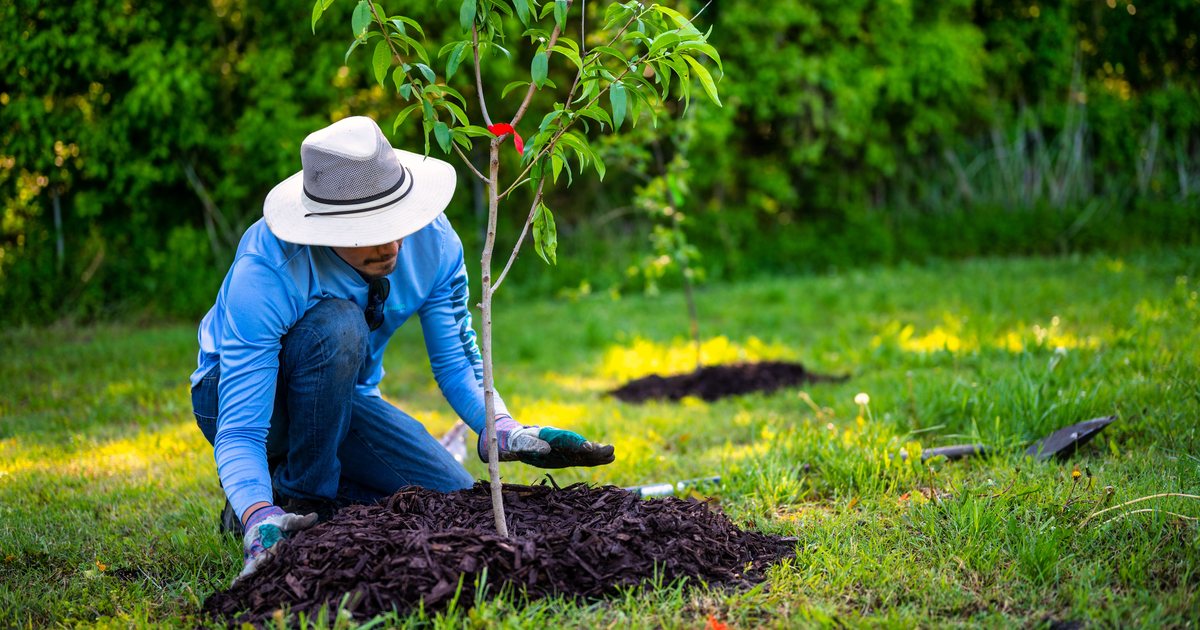
There’s one mature tree near the back corner of the yard, and when we planned the turf layout, the installer’s original suggestion was to run turf right up to the base of the trunk for a clean look. We pushed back on that and left an eighteen-inch ring of mulch around the trunk instead — a decision made mostly on instinct at the time, not because I had a specific reason. What tipped it wasn’t anything technical: a neighbor a few houses down had turf laid tight against a tree, and within a couple of years that tree’s canopy had noticeably thinned out on the side closest to the turf edge. Nobody could say for certain the turf caused it, but it was enough of a pattern that I didn’t want to find out the same way. So before the crew showed up with base material, I walked the yard with the installer and we marked out a buffer instead of letting the layout run edge to edge like the rest of the plan called for.
Why Turf Right Up to the Trunk Causes Problems Later
Turf right up to a trunk means compacting soil close to the tree during base prep, which reduces the oxygen and water exchange the roots underneath depend on, and it means the trunk’s root flare (the base of the tree where trunk meets root, which needs to breathe and can be damaged by material pressed against it) sits under artificial material instead of open ground. None of this shows up as an immediate problem — it’s a slow decline that can take months or longer to become visible in the canopy, by which point it’s a lot harder to trace back to the turf installation as the cause. Non-permeable turf backing installed too close to a trunk can also meaningfully block water and oxygen from reaching root systems that were previously getting both directly through open soil.
There are really two separate mechanisms at work, and it’s worth telling them apart because the fix for one isn’t automatically the fix for the other. The first is compaction: getting a firm base under turf means running a plate compactor over several inches of crushed rock, and that compaction doesn’t stop cleanly at some invisible line — it presses the soil’s pore structure shut well beyond wherever the compactor actually rolled, and roots exchange oxygen through that pore space the same way they take up water. The second is grading. Base prep resets the slope of the ground for proper drainage, and depending on which way that new grade runs, it can send water that used to pool and soak in around the trunk off toward a drain line or the yard’s low point instead — so a root zone that used to get soaked every time it rained can end up noticeably drier, even with a permeable turf backing letting water through wherever it does land.
What We Did Instead
- Kept a mulch ring of roughly twelve to eighteen inches around the trunk rather than running turf to the base — enough to let the root flare breathe and keep base compaction away from the tree’s most sensitive root zone.
- Avoided heavy equipment directly over the tree’s root spread during base compaction, working that section by hand instead of with a plate compactor.
- Left the turf edge around the mulch ring loose enough to lift for future root inspection rather than gluing it down tight to the ring’s border.
- Skipped aggressive edge-grading right at the ring boundary, since cutting a clean, deep edge there risked severing structural roots close to the surface.
None of that was about doing less work — hand-compacting around a root zone and leaving an edge unglued is slower than running the compactor straight through. There was a shortcut available and we didn’t take it: poking drainage slits through the backing near the trunk, or gluing the whole edge down tight, would have addressed the water-infiltration half of the problem without touching the compaction half — and compaction is the part that does the real damage, since it happens during installation itself rather than slowly afterward. Once soil near a root flare has been compacted, there’s no loosening it back up without digging, and digging that close to a mature tree’s roots just trades one kind of damage for another.
This mattered more here because the tree is already mature. A younger tree probably doesn’t need as wide a buffer yet, and a tree planted after the turf is already down needs the buffer built in from the start rather than cut into finished turf later.
If You Have a Tree Anywhere Near the Planned Turf Area
A mulch ring around any tree trunk, sized to at least the edge of the root flare, is worth the small loss of lawn coverage — a strip of turf that dies back or needs replacing later because a tree declined is a bigger loss than the mulch ring ever was. If you’re not sure how far a specific tree’s roots or flare extend, that’s worth checking (or asking an arborist) before finalizing where turf gets laid, rather than guessing at the buffer distance.
Checking on the Tree After the Turf Went In
I still walk past that tree a few times a year and check the mulch ring as much as the canopy — if it’s compacted down flat or washed thin, I top it off rather than let bare soil sit exposed at the base. That’s a five-minute job with a bag of mulch, not a project. In a hot, humid climate, the bigger seasonal factor isn’t the turf itself so much as when the base-prep work around a tree gets scheduled — digging and compacting close to a root zone during the hottest, most humid stretch of the year piles heat stress on top of whatever the tree is already managing, so if I were doing this again I’d push any tree-adjacent work to a cooler, drier week instead. So far, the canopy on that side of the tree looks the same as it did before any of this started, which is really all I was hoping for.