
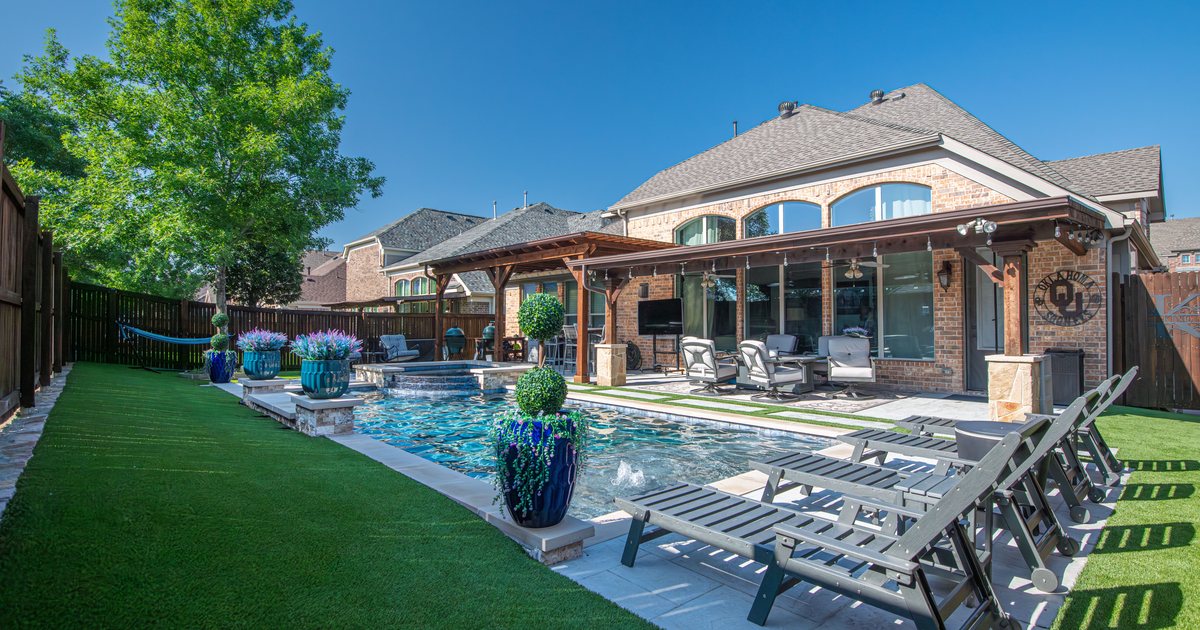
Two months after installing 320 sq ft of turf in my backyard, I felt the ground give slightly underfoot near the patio door — a soft, spongy feeling that hadn’t been there the week before. By the following weekend it wasn’t subtle: a roughly 2-foot-wide depression, visibly lower than the surrounding turf, right where both dogs kept turning sharply on their way outside. Pressing down with my palm, it compressed like there was nothing solid underneath. This is the specific failure, why it happens, and the fix that’s held for a full year since.
Why Turf Sinks After Installation
Sinking almost always traces back to the base layer, not the turf itself. Crushed base material like class II road base mixes larger aggregate with fine particles, and when compacted at the right moisture level, those fines migrate into the gaps between the bigger stones and lock the layer together into something close to solid. Skip that step and the base looks flat and finished on top but is really just aggregate resting loosely on itself, full of tiny voids. Foot traffic doesn’t create those voids — it just keeps finding them, pressing more material into the gaps each pass until there’s a visible low spot.
A second thing worth checking, even though it wasn’t what got me, is uneven base depth: a thinner section compacts down faster under the same traffic a thicker one shrugs off. I measured my sunken spot’s base against a section near the fence line graded off the same string line, and both were close to the full 3 inches — so in my case it was compaction quality, not a thin spot, which let me skip re-grading.
It’s also worth ruling out drainage before assuming compaction, since that’s the other common cause and the fix is different. If the spot stays damp or holds water after rain, that points to drainage — standing water softening the base from below — and the fix is a French drain or gravel-filled trench, not more base material. Mine was bone dry when I dug into it, which told me this was compaction, not water.
The Real Cause: Dry Compaction
In my case, I compacted a 3-inch layer of class II road base while it was bone dry. I’d rented the plate compactor for the day and wanted the base pass done before the afternoon heat got miserable, so I skipped wetting it down first — harmless-feeling at the time, and the entire problem in hindsight. Dry base shifts under a compactor instead of locking together, rearranging loose aggregate rather than packing fines into the gaps, so it looks flat and firm right after with no real stability underneath. Digging into the failed spot two months later, the base came up as loose, dusty material I could crumble in my hand — nothing like the fence-line base, which held together in a solid clump.
The Fix That Actually Held
- Pulled up a 6×6 ft section of turf around the sunken area.
- Broke up and removed the loose base material.
- Re-laid road base in 1-inch lifts, lightly wetting each lift before compacting — damp enough to hold a shape when squeezed by hand, not soaked.
- Re-compacted each lift separately rather than the full depth at once.
- Re-seamed the turf back into place and re-brushed the infill.
The step I was most tempted to shortcut was re-compacting in separate 1-inch lifts instead of dumping the full depth back in and running the compactor once. It’s slower, closer to three passes than one, but a plate compactor only transmits real force a couple of inches deep before it dissipates. Compact 3 inches in a single pass and you get a firm-looking top layer on the same loose material that caused the problem — lifts are the only way I’ve found to get density all the way through, not just at the surface.
Worth knowing: a sunken spot bigger than a couple of feet across, or more than one soft spot in the yard, suggests the original compaction was rushed across a wider area rather than missed in one pinch point. I only fixed one 6×6 ft section because the rest of my base held up fine under lighter traffic — a whole-yard dry-compaction job tends to show up as several sinking spots over time, not just one.
Total cost for the repair: about $60 in materials and a lost Saturday. It’s held with no further sinking for over a year, including through last year’s rainy season.
How to Prevent It the First Time
Water the base lightly before compacting — enough that a handful holds together, not so much that it’s muddy. Compact in 1-inch lifts rather than all 3 inches at once, and pay particular attention to any spot where traffic will pivot or concentrate, like doorways and gate paths — those need extra compaction passes, not just extra base depth.
If You’d Rather Hire It Out
Before fixing this myself, I called two local landscaping crews for a quote, mostly out of curiosity about whether $60 and a lost Saturday was actually the better deal. Both said they’d check compaction versus drainage first, the same way I did with a test hole, before pricing anything — and both priced a compaction re-fix like mine as a small job, separate from a drainage fix, which runs more since it usually means trenching and drain pipe. Neither would commit to a number without seeing the yard, but both agreed an isolated soft spot like mine is about as cheap as turf repairs get.
It’s now been a full year since I redid this section, spanning last year’s rainy season plus the hottest, driest stretch of summer, when the ground underneath shrinks and swells more than people expect — the real test for a base repair, and mine hasn’t moved. Next time, I’d want to catch any new soft spot in early spring, before summer heat makes digging miserable and the rainy season muddies the work.