
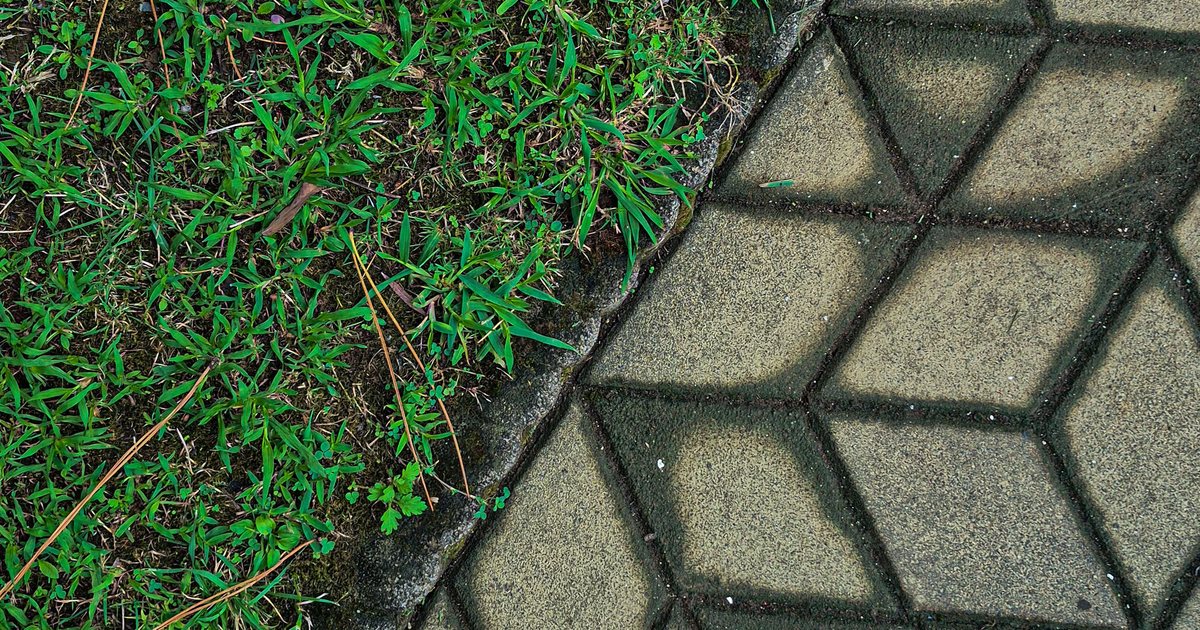
Along the strip where the lawn meets the patio pavers, there’s about a six-foot stretch where you can see a thin sliver of tan backing material peeking out from under the green blades — not the whole border, just that one section, and only really noticeable in the late afternoon when the sun comes in low across it. I must have walked past that spot two dozen times over the three weeks since the install before it actually registered as a problem. The first afternoon it caught my eye, I crouched down and ran my thumb along the paver joint, assuming it was a streak of dried mud that had settled into the seam. It didn’t wipe away. Looking closer, the tan wasn’t a stain at all; it was the woven backing material itself, showing through because the pile above it had nothing left to lean over and hide it.
Why One Section Shows and the Rest Doesn’t
The rest of the perimeter looks fine because the turf was cut with a slight overhang past the hard edge everywhere else, so the pile naturally droops down and covers the trimmed edge underneath. That one stretch got cut flush instead of slightly long — probably a small miscalculation while working around a curve in the paver line — which left just enough backing exposed that the blades above it can’t fully hide it. It’s a trim problem, not an installation-quality problem; the seam and fastening in that section are perfectly solid, it’s purely cosmetic.
There’s a second factor working against that particular spot, too. Turf comes off the roll with a slight lean or “grain” baked into the pile, and along most of my border that grain leans out toward the pavers, which is exactly the direction that helps disguise a trim that’s even a touch short. Right at the curve where the short section sits, the border angles closer to perpendicular with that grain, so the blades stand more upright instead of draping sideways over the edge. A short trim on its own might have gotten away with it; combined with pile that isn’t leaning the right way to compensate, the backing had nowhere to hide. It’s also genuinely hard to catch at final walkthrough, since most people check a new install at midday, when the sun doesn’t rake across the border at the angle that exposes it.
Fixing a Short-Trimmed Edge
- Checked whether there was enough slack in the turf to pull it slightly further over the border by hand — sometimes a short trim isn’t actually cut too short, it’s just not pulled far enough over the edge.
- In this case there wasn’t enough slack, so I cut a narrow strip from an offcut piece left over from the original install, matching pile height and color.
- Fit that strip underneath the existing edge, backing-side up, to build the width back out so the existing blades would have something to drape over again.
- Re-glued the edge down with turf adhesive rated for the paver surface, weighted it for a day, then brushed the pile back down over the repaired section.
I did consider a shortcut before committing to that: turf-safe colorant sold for touching up exposed backing, dabbed over that tan sliver, would have taken two minutes instead of a day of drying time. I skipped it. Colorant sits on top of the backing rather than becoming part of the pile, and in direct afternoon sun it fades faster than the surrounding fibers — within a season you’d likely trade a tan stripe for a slightly-wrong-green one. Rebuilding the actual width so the existing blades have something real to drape over takes longer up front but doesn’t ask to be redone.
If your short section falls on a curve rather than a straight run, like mine did, cut the patch strip wider than you think you need and trim it to fit once it’s dry-laid in place, rather than cutting to a single measurement first — a curve eats more width on the inside of the bend, and a strip sized for the straight sections nearby will come up short right where the curve is tightest.
Is This the Same as a Seam Lifting?
Worth ruling out before you assume it’s a trim issue: a short-trimmed edge shows a flat, even sliver of backing that’s roughly the same width along its whole length and doesn’t move if you press on it. A lifting seam looks different — the exposed line is uneven, gets wider toward one end, and the turf on either side will flex or gap if you press near the join. Mine was flat and consistent along the whole six feet, which told me it was a cutting issue rather than an adhesive failure underneath.
Checking Your Own Border Before It Becomes Obvious
Walk your entire perimeter at the time of day the sun comes in lowest across your yard — that’s when a slightly short trim is most visible, and it’s often invisible at midday when most people happen to inspect a new install. If you catch a short section early, it’s a five-minute fix with a spare offcut; if the leftover material from your original installation gets thrown out, keep a small remnant specifically for this kind of border touch-up. That patch has been down through one full summer of heat and afternoon storms now without lifting or discoloring differently from the rest of the border, so I’m treating it as a permanent fix rather than something to keep watching.