
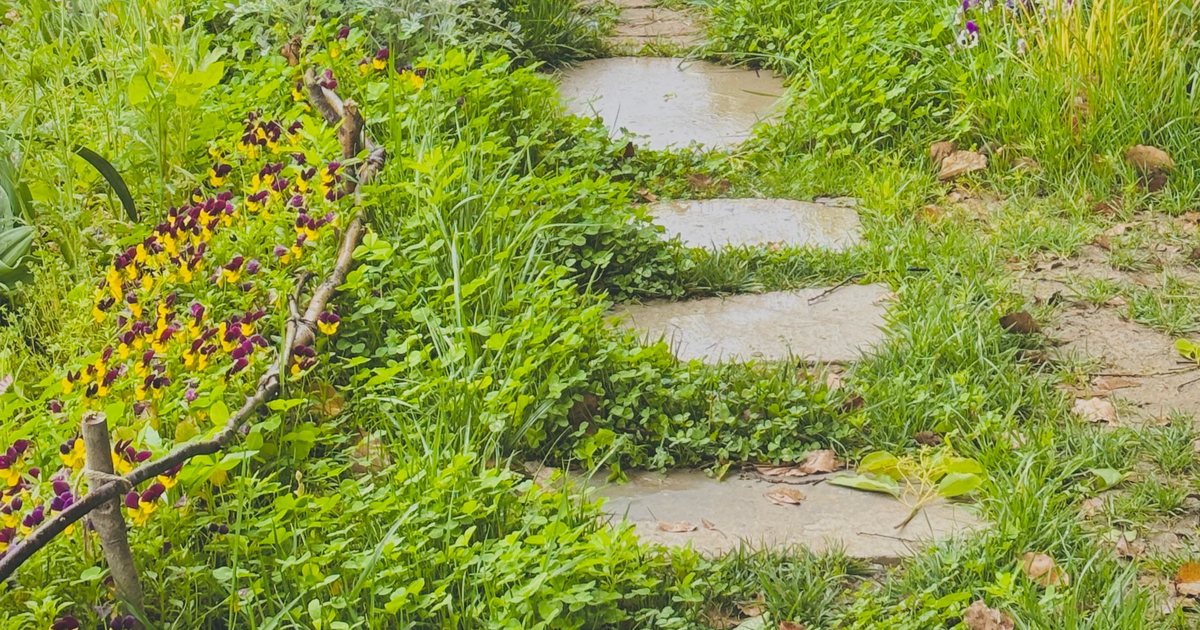
There’s a direct line from the patio door to the side gate that everyone in the house walks, dozens of times a day without thinking about it. Within about five months, that exact path had packed down into a visibly darker, flatter track compared to the turf a foot on either side of it — you could see the route just by looking at the lawn from the kitchen window.
I didn’t clock it as an actual problem right away. For the first few weeks it just looked like the blades in that strip were leaning a little more than the rest of the lawn, the kind of thing you’d blame on someone dragging a chair across it. What actually got my attention was walking it barefoot one evening — the rest of the lawn still had its usual slight give underfoot, but the path felt closer to standing on a thin rug over concrete, with almost no cushion left. I pressed a hand flat into the fibers on the path, then again a few feet off to the side: the off-path blades sprang back up within a couple of seconds, while the path fibers stayed pressed down and only lifted partway even after I worked them by hand.
Why a Walked Path Wears Differently Than the Rest of the Lawn
Occasional foot traffic across open turf doesn’t cause lasting matting, because the fibers have time to spring back between uses. A repeated, narrow path is a different kind of stress entirely — the same few inches of turf get compressed dozens of times a day, every day, with no real recovery time in between, so the fibers gradually lose their ability to spring back at all in that exact strip. It’s less about how much total weight crosses the lawn and more about how concentrated it is onto the same narrow line, which is why a well-used path mats down long before the rest of a yard that gets plenty of foot traffic overall.
There’s a second factor that made it worse in my yard specifically: afternoon heat. Blades sitting in direct summer sun get noticeably warmer and slightly softer to the touch, and a softer fiber compresses more easily and takes longer to recover than the same turf on a milder, cloudier day — so the same number of footsteps did more damage on a scorching afternoon than a cooler one. Repeated compression on that strip was also working the infill sideways a little at a time, the way granules shift under a grinding, twisting step rather than a straight-down one. Less infill under the blades meant less support holding them upright, so that path matted down faster than a simple traffic count would predict.
What Actually Slowed It Down
None of this needed anything expensive, but the order and direction mattered more than I expected going in:
- Cross-brushed the path against the direction of travel with a stiff-bristle push broom — brushing with the direction people walk just re-lays the fibers the same way they were already being pushed.
- Ran a leaf blower over the path at a low angle a few inches above the surface, which lifts fibers that hand-brushing alone doesn’t fully reach.
- Worked a bit of additional infill into that specific strip, since infill is what actually holds blades upright under repeated pressure — a thin spot in infill along a heavily-used path speeds up matting.
- Set a standing reminder to cross-brush that specific path every couple of weeks rather than waiting for the whole yard’s normal maintenance schedule, since it wears faster than everywhere else.
The stiff push broom did more in fifteen minutes than a soft-bristle rake managed in twice that time on an earlier attempt — a rake mostly pushes debris and loose infill around on top, while a stiff broom gets down between the blades and lifts them from the base. On a wider high-traffic area, like a stretch in front of a garage door where more than one person crosses at odd angles, I’d expect the same routine to just take longer, not need a different technique — more surface, same tools.
It’s noticeably better, though the path still mats down faster than the surrounding lawn between brushings — that seems to be a permanent characteristic of a heavily used route rather than something a single fix eliminates for good.
Matting Isn’t the Same Problem as a Sinking Base
It’s worth separating this from a different problem that can look similar from a distance: a soft or sunken spot in the same well-walked path, rather than just flattened fibers. The way I check is simple — brush the area hard with the stiff broom, then look at it again a few minutes later. If the blades lift back up and the surface looks close to level again, it’s fiber matting, and brushing plus a bit of extra infill is the right fix. If the ground underneath still feels noticeably lower than the surrounding turf after brushing, or you can feel a soft give under your heel that isn’t just infill compressing, that’s the base settling, not the fibers matting — and that calls for digging into the base material, not more brushing.
The Realistic Expectation
A high-traffic path is never going to look identical to the rest of the lawn between maintenance sessions — the honest fix is a shorter, dedicated brushing cycle just for that strip, not a one-time repair that makes the wear pattern disappear permanently. If you know where the heavy-traffic routes across your own yard will be before installing, a slightly higher infill fill in just those strips is worth the extra material cost.