
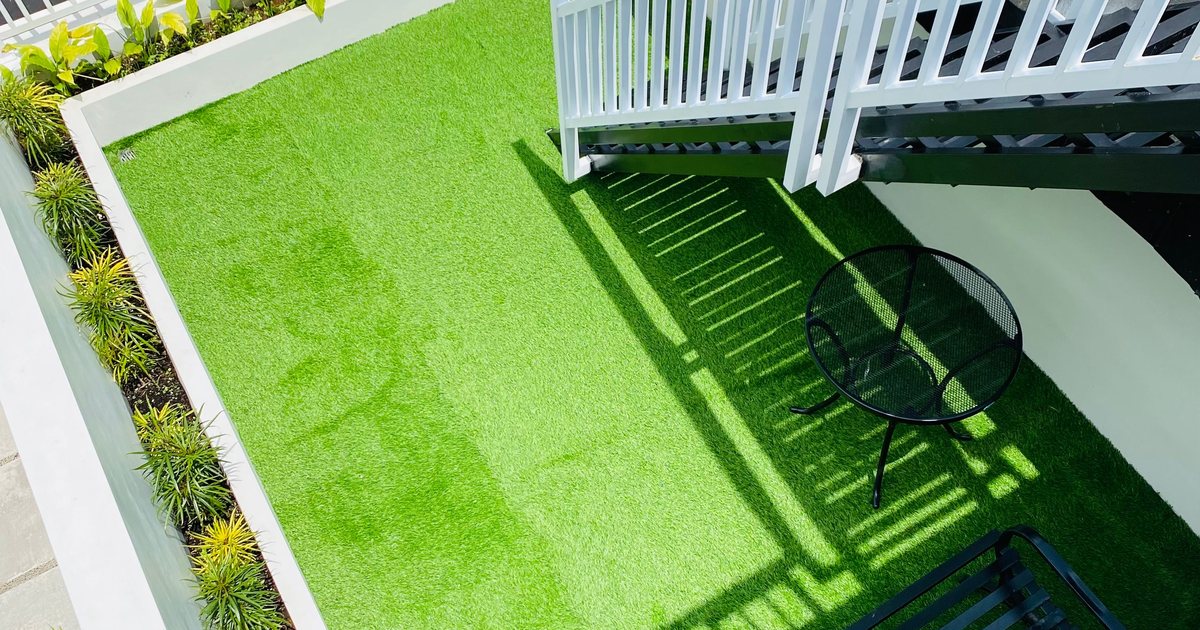
We framed a small turf inset with pavers near the pool deck — a roughly 4×6 ft rectangle meant to break up the hardscape a bit. I laid the turf straight over the existing paver base underneath, figuring pavers were already flat and stable so there was nothing to prep. The first sign something was off wasn’t even standing water — it was the smell. A few days after a heavy afternoon storm, that corner of turf had a faint sour, mildewy smell the rest of the yard didn’t have, and when I pressed a hand into the pile it felt cool and slightly spongy instead of just damp. I figured it would dry out on its own. It didn’t, not fully, and by the next rain the same spot held a visible puddle for almost an hour longer than the surrounding lawn — long enough that my kids stopped cutting across that corner because their shoes came back wet.
The Step That Gets Skipped
On real soil, water drains down through the base material — crushed rock, then native soil, then it’s gone from view even if it’s still moving somewhere underneath. On pavers or concrete, there’s nowhere for water to go except sideways or through whatever gaps exist, and a solid hardscape surface has essentially none. Laying turf and a thin layer of infill directly on top of a hard, flat, non-porous surface without adding any drainage path underneath just relocates the puddle from the pavers to on top of the turf instead of fixing it.
There was a second factor working against that particular inset, and it took me longer to notice than the flat surface itself. The pavers had been set with a very slight back-slope toward the house instead of away from it — probably fine as open hardscape, but under turf that tiny slope was enough to steer the little water that did move toward one low corner instead of spreading out across the whole rectangle. A flat hard surface under turf is bad enough on its own; a hard surface that’s also subtly graded the wrong way turns one specific corner into the spot that holds water every single time it rains, which is exactly the pattern I was seeing.
Fixing the Section That’s Already Down
- Pulled the turf back and drilled a pattern of 3/8-inch weep holes through the pavers at roughly 12-inch spacing, angled slightly so water has somewhere to go rather than sitting flush.
- Added a thin layer of crushed stone (about half an inch) directly on the pavers before relaying the turf, giving water a path to those weep holes instead of pooling on a flat surface.
- Re-laid the turf and re-secured the edges with turf adhesive rated for hardscape bonding, since standard ground staples obviously don’t work on pavers or concrete.
I drilled the weep holes at 12 inches instead of spacing them further apart because I wanted at least two holes reachable from any point in that low corner — one hole every couple of feet sounds like plenty until a single row down the middle leaves the edges just as wet as before. I also considered skipping the crushed stone layer and drilling straight into the pavers, which would have been faster — but the holes alone don’t do much if the turf backing is still sitting flush against a flat surface between them. The stone is what actually gives water somewhere to travel toward a hole instead of just sitting on top of the pavers until it evaporates.
The standing water is gone; a hard rain now drains within about the same time as the rest of the yard. It’s held up through this whole summer’s storms so far, including a couple of the heavier ones we get in August, so I’m treating it as fixed rather than just improved. That said, it’s the kind of fix I’d check again after a full year rather than assume it’s permanent — infill and crushed stone both settle a little over time, and a weep hole can silt up if fine particles from the infill work their way down into it.
How to Tell This Apart From an Infill Problem
Before I traced this to the flat pavers, I half-suspected it was just old, compacted infill holding water instead — that’s a different problem with a much easier fix, and it’s worth ruling out first. Compacted infill usually shows up as water sitting evenly across a broader area and soaking in slowly rather than pooling sharply in one spot, and raking the pile open with a stiff broom usually helps at least a little. A drainage problem from a hard surface underneath does the opposite — raking the top does nothing, because the water was never stuck in the infill in the first place, it’s sitting on pavers or concrete with nowhere to send it. If a spot holds water in the exact same corner every time no matter how much you groom the surface, that’s the hard-surface tell, not an infill one.
If I’d been hiring this out instead of doing it myself, I’d have wanted whoever came out to check the paver slope with a level before touching a drill — a five-minute check that tells you exactly where the low point is and how many holes you actually need. A small patch job like mine isn’t really big enough to justify its own service call for most installers; it’s the kind of thing that gets bundled into a bigger callback, or handled DIY the way I did it.
If You’re Planning This From the Start
Drilled weep holes and a thin drainage layer take maybe an extra hour on a small inset like ours, and it’s a lot easier to do before the turf goes down than to pull it back up afterward. If you’re covering a bigger patio or a full concrete slab with turf, this matters even more — plan the drainage path before you plan the turf layout, not after. In a hot, humid climate like mine, don’t wait for a dry stretch to check for slope problems, either; the pooling is obvious right after a storm and basically invisible the rest of the time, so the best window to catch a bad grade is within a day of the rain that reveals it, not weeks later when the puddle’s long gone.